

Volume 6- Indigenomics CREATORS TECH JAM: Prototyping a Relational Economy

Last week marked the inaugural Indigenomics Creators Teach Jam Session, a new Indigenomics initiative that brings Indigenomics into the act of creation by gathering designers, technologists, artists, builders and knowledge holders to translate Indigenous economic design into prototypes and experiences people can participate in.
The Indigenomics Creators Jam Session is a gathering of values-aligned technologists and builders (web, product, AI, creative tech), artists and designers (experience, interaction, story, visual, systems), entrepreneurs and community builders (people who understand real-world exchange, trust, and participation), students and emerging makers (learning fast, building with guidance), and Indigenous economic design practitioners and relational knowledge holders (grounding the work in governance, responsibility, and continuity), who are coming together to prototype digital experiences that make an Indigenous-led relational economy participatory and lived, bringing Indigenomics into the act of creation where values become systems and principles become pathways people can step into. This session is in partnership with Northeastern University, the University of Victoria and with access to advanced intelligence computing infrastructure powered by NVIDIA H200 within TELUS hyper scale environment.
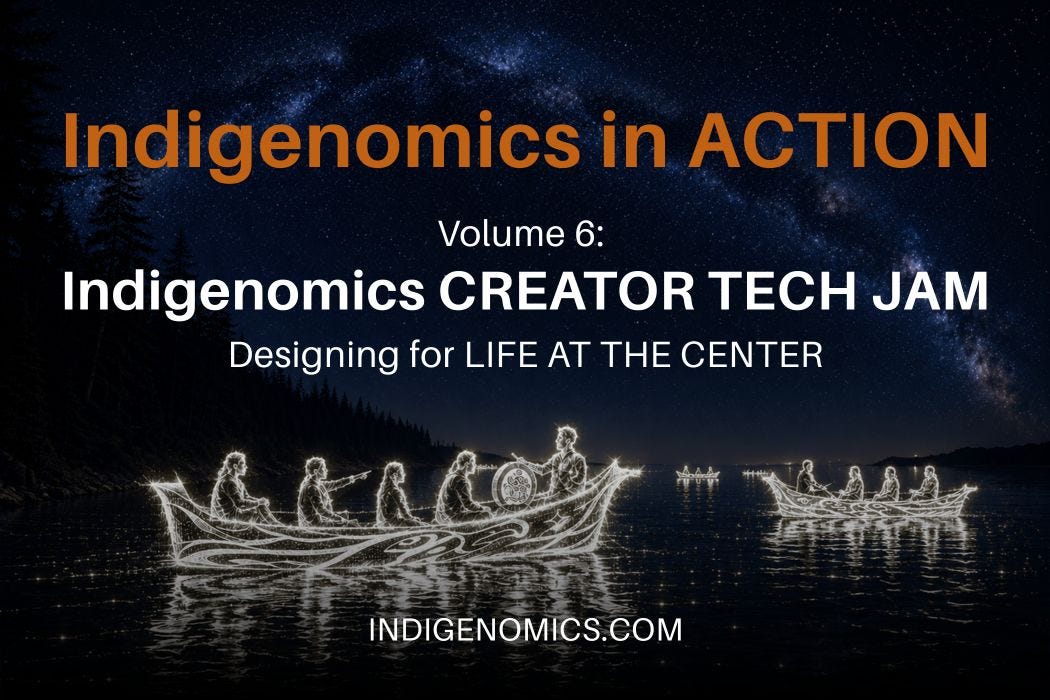
For Indigenous Peoples, the canoe carries more than people. The canoe carries knowledge, protocol, roles, and responsibility across water and across time. The canoe moves because each paddler brings a strength, keeps rhythm with others, and stays accountable to a shared direction. The canoe also stands as a technology: a precision-designed system for movement, coordination, safety, and survival, built from deep intelligence about materials, water, weather, the natural world and human roles. The canoe holds architecture, governance, and interface all at once, translating relationships into a working vessel that works in real conditions.
In the Indigenomics Creators Jam, each team becomes a canoe. Each canoe carries a different set of gifts, skills, capacities and questions, and the work advances through collaboration, coordination, and trust. The Jam becomes a canoe gathering where ideas travel together, get tested in real conditions, and return to shore as prototypes that can keep moving.
“The Indigenomics Creators Jam is what happens when we stop asking people to understand Indigenomics in theory and start inviting them to build it in practice. We are gathering builders, technologists and knowledge holders to translate the core building principles of ‘Life at the Center’ and ‘Code as Ceremony’ into real experiences people can step into, so value flows through participation, contribution, and reciprocity, and the future economy becomes something we can feel, witness, and carry forward.” Carol Anne Hilton, Host and Founder
The Creator Jam carries a shared destination. The canoe travels forward because the direction is clear, and every paddle in the water aligns to that direction and focus. In this work, the design question becomes the destination marker on the horizon. It concentrates the imagination of the teams into one disciplined aim, and it turns collaboration into coordinated movement toward a single outcome: a digital experience that makes an Indigenous led relational economy visible in action through participation, contribution, reciprocity, and the movement of wealth among participants. How might we design a digital experience that recognizes and amplifies a relational economy at the Life at the Center Festival, where value emerges through participation, contribution, reciprocity, and the movement of wealth among participants?
Most important is the design question because it gives every team the same direction and turns the Jam into focused economic design work. It matters because the question transforms Indigenomics principles into working experience, where people can participate in a relational economy and feel value moving through participation, contribution, and reciprocity. It matters because the Creators Jam produces prototypes that make relational value visible and legible in action, which strengthens how partners, communities, and institutions understand what an Indigenous led economy is and how it operates. It matters because the shared destination aligns teams into coordinated movement, like a canoe traveling with clear direction and collective rhythm, and it brings collaboration into one accountable purpose that carries forward into Life at the Center.
The Creator Jam moves as a canoe gathering with a shared destination on the horizon. Life at the Center and Code as Ceremony operate as the two guiding principles that shape direction and discipline at the same time. The design question functions as the navigational instruction that keeps every team aligned as they build.
These following points hold the shared direction of the concept of the canoe gathering and name what each team carries into the water as they build a relational economy into lived experience-
Life at the Center sets the destination. It names the economy we are building toward, where life, dignity, continuity, and community benefit become the measure of success.
Code as Ceremony sets the method. It turns every interaction into an accountable threshold, where onboarding, consent, exchange, and data practices carry intention and respect.
Together they form a dual standard. Life at the Center defines what the system must protect and grow. Code as Ceremony defines how the system moves people through participation with care and clarity.
Life at the Center answers “what value is.” It defines value as something created through relationship, responsibility, reciprocity, and place based governance, not only through price.
Code as Ceremony answers “how value moves.” It shapes the steps, rituals, permissions, and interfaces through which value circulates, so participation becomes felt, legible, and meaningful.
The design question locks both principles into one demand. It requires a digital experience that amplifies a relational economy where value emerges through participation, contribution, reciprocity, and the movement of wealth among participants.
The design question makes the Jam practical and measurable. It turns philosophy into a build brief, and it sets the test as lived experience rather than abstract agreement.
The design question forces real design choices. It drives decisions about what gets built, what gets protected, what stays local, what stays with the participant, and what remains governed by consent.
The design question turns the Jam into an economic laboratory. It positions each prototype as a working hypothesis about how a relational economy can be experienced through systems, not only described through language.
The duality shapes the collaboration. Life at the Center holds the shared purpose. Code as Ceremony holds the shared discipline. The canoe gathering moves as one journey because direction and method stay aligned.
Indigenomics serves to uphold living economic truth. Indigenomics carries Indigenous governance, Indigenous wealth, and Indigenous economic power forward through relationship, responsibility, and continuity. Indigenomics sets a standard for what value means when life stays at the center of every decision.
The Indigenomics Creator Jam brings that standard into creation. The Creator Jam gathers builders, makers, artists, designers, technologists, entrepreneurs, students, and community builders into one shared act of economic design. The Creator Jam turns Indigenous economic principles into lived experiences. The Creator Jam turns vision into prototypes that people can step into, understand, and carry forward. The design question sets the direction. It serves to place relationship at the center of value. This question places contribution at the center of wealth. This question serves to place reciprocity at the center of economic design. This question places the movement of wealth inside community, place, accountability, and meaning.
This question also turns design into responsibility. Every system carries a worldview. Every interface teaches a way of being. Every flow shapes what people believe is normal, possible, and valuable.
Just by asking this design question, we make a different economy possible. We make it possible to treat participation as value, as the generative economic force that relational economies have always recognized as central to prosperity, and that the Creator Jam serves to carry forward into digital form. We make it possible to design reciprocity on purpose, with real architecture and real consequence, so that the system itself rewards giving, stewardship, and contribution. We make it possible to see how value and exchange flows through participation and reciprocity, so contribution and responsibility become visible and respected in the system.
“The Creators Jam is where we stop decorating technology with values and start weaving values into the system itself. We turn Indigenomics principles into living architecture, and we engage the concept of ‘code as ceremony’ into the journey, so that consent, reciprocity, and responsibility are the user experience. The design question is the direction in the water. Every team paddles toward the same point: a relational economy that becomes usable and lived, where people can step in, practice, participate, and feel it working with Life at the Center.” Pravin Pillay, Creative System Lead at Indigenomics
By activating this question, we make it possible to turn Indigenous economic principles into activated practice. We make it possible to build toward Life at the Center with discipline and shared direction, because the question becomes a common destination that aligns builders, makers, and collaborators into coordinated forward motion.
That is what a powerful design question does. It changes what we build, what we hold and honor, and what we choose to carry forward. It makes the future of economy something people can feel and experience. That is the power of the question. This is Indigenomics.
INDIGENOMICS.COM info@indigenomics.com
#indigenomics #indigenomicsAI #indigenousAI